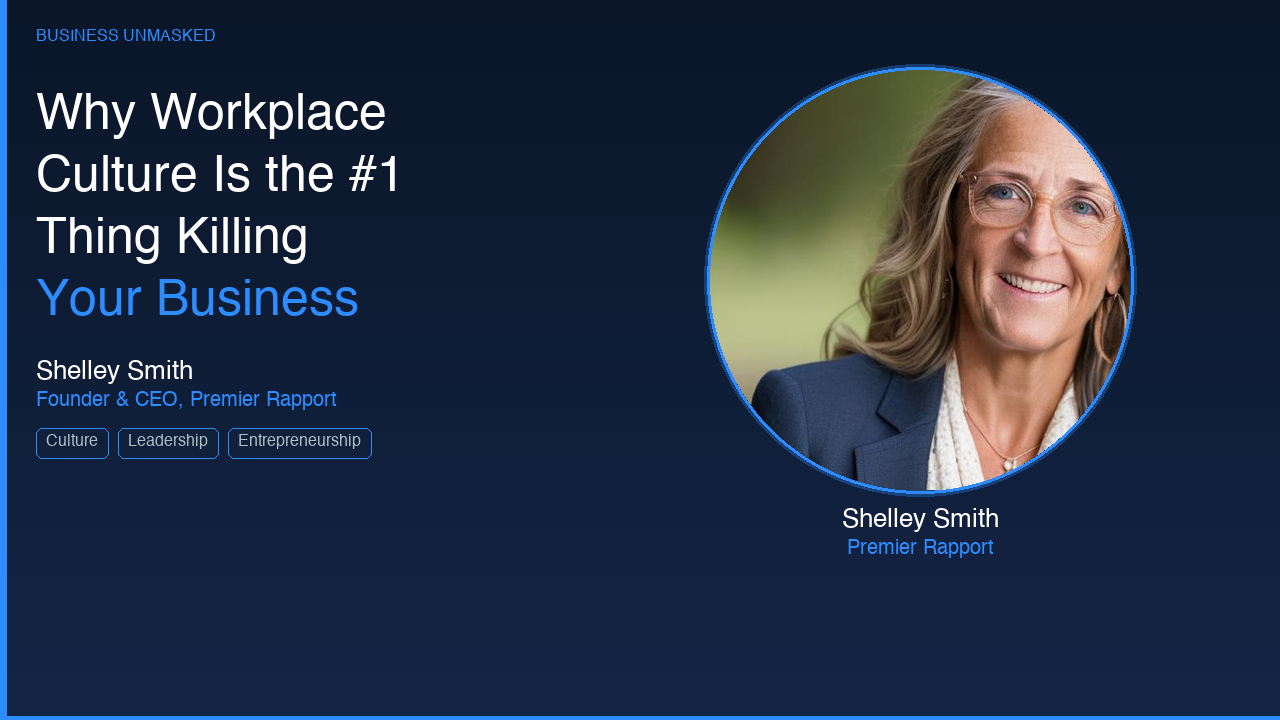
From Flea Markets to Fortune 500 Culture Consulting
What does it take to fix a broken workplace? Shelley Smith has been answering that question for nearly four decades. Starting at age 11 in her parents' flea market and auction house, Shelley developed an intuitive understanding of how people interact, build trust, and create environments where everyone can thrive.
After 14 years at Marriott — where she internalized their "employees first" philosophy — and another 8 years on the franchise side where she experienced firsthand what disengagement looks like, Shelley founded Premier Rapport with a simple but powerful tagline: Culture Matters.
"I lived those toxic culture environments. And I've lived the great environments and the ones in between. I don't think people should work in environments that just don't match them. There's a better way."
The #1 Mistake Leaders Make in Meetings
The biggest pattern Shelley sees after decades of consulting? Leaders who ask for input and then immediately start talking again. They don't wait for responses. They answer their own questions. And then they wonder why they're the only ones talking in their meetings.
The second mistake is even worse: when a leader does pause and someone shares honest feedback, they dismiss it. "No, that's not right. That can't be real." After that, the next time the leader asks? Crickets. Nobody will speak up again after being embarrassed or dismissed.
Shelley references Jeff Bezos's approach: he deliberately speaks last in meetings, letting everyone share freely before he weighs in. "If he can do it at that level," Shelley says, "nobody's really above it."
"I've been asked in and the question is 'we don't have any engagement, nobody shares opinions.' I'll come into a meeting and I'm like, yeah, they're not sharing opinions because you're not giving them a chance to — and you don't really want their opinion."
What Military Special Ops Taught Her About Leadership
Through her work with the Honor Foundation, Shelley coached special operations veterans transitioning to corporate careers. The discipline, the unit cohesion, the unwavering "I have your six" mentality — she calls it "unlike anything I've ever experienced."
But the biggest culture shock for these operators? In the military, when a superior gives an order, you follow it. In corporate America, just because your boss says something doesn't mean people will actually do it. That gap between military discipline and corporate reality is where Shelley's coaching becomes invaluable.
The Garden Framework for Culture
Shelley thinks about culture like tending a garden. You plant seeds, water them, pull weeds, and create the right conditions for growth. Leave it unattended and weeds take over — but that doesn't mean there's no garden. Similarly, remote teams who think they "don't have a culture anymore" are wrong. The culture is there whether you tend it or not.
"How do you message on Teams? What's the frequency — video on, video off? How are timelines managed? How do we problem solve? How do we onboard? All of that is part of your culture," she explains.
Key Takeaways
1. Culture exists whether you manage it or not. Remote or in-person, every team has a culture. The question is whether you're intentionally shaping it or letting it happen by default.
2. The leader who speaks first kills the conversation. If you want real input from your team, speak last. Create space for honest dialogue.
3. Dismissing feedback is worse than not asking. If someone shares an honest opinion and you shut it down, you've guaranteed they'll never speak up again.
4. Cross-disciplinary experience is a superpower. Shelley's journey from flea markets to Marriott to military coaching gave her a perspective no single career path could.
5. Find a culture that matches who you are. Don't force yourself into environments that don't fit. There are companies across every industry doing the same work with completely different cultures.
Topics Covered
Click any line to jump to that point in the audio.
AI Edit Summary
Edit Decision Log
Production Pipeline
Every step of this episode was processed automatically. Here's exactly what happened.
1. Downloaded from Riverside
Pulled 992MB MP4 via Playwright browser automation from share link
2. Extracted Audio
FFmpeg extracted 44:13 of audio as 16kHz mono WAV (82MB)
3. Transcribed with Whisper
OpenAI Whisper (base model) — 446 segments, 7,860 words in 3 minutes
4. AI Filler Analysis
Identified 43 um/uh/ah, 120 "you know" fillers, 24 dead air segments (>1.5s pauses)
5. Executed 185 Cuts
FFmpeg filter_complex with atrim + concat removed 1:57 of filler and dead air
6. Audio Cleaning & Mastering
Noise reduction, 80Hz HPF + 15kHz LPF, soft compression, loudness normalization to -16 LUFS
7. AI Intro Voiceover
Custom intro script generated from episode content, voiced with Edge TTS (Guy Neural), 39 seconds
8. Final Assembly
Stitched intro + 1.5s silence + edited episode — 42:58 final, 192kbps MP3 (59MB)
9. Metadata & Thumbnail
AI-generated title, description, tags, and 1280x720 branded thumbnail
10. QA Review
Loudness: -17.2 LUFS | Peak: -1.0 dBFS | All checks passed
Choose Intro Voiceover
Listen to each voice option and pick the one that fits best. The episode currently uses Andrew.
Want even better quality? ElevenLabs can produce studio-grade voiceovers with human-like intonation. If you have an API key, we can swap these out instantly.